Camping brings your family together in ways day-to-day life rarely does. You’ll find simple, fun activities that fit every age and energy level—hikes, campfire games, nature crafts, and scavenger hunts that turn the campsite into a playground and classroom at once. Choose a few easy, tested activities and your trip will spark laughter, curiosity, and memories that last long after you pack up.
This post guides you through hands-on outdoor games, nature-based projects, and easy ways to make every moment count so you can focus on fun instead of logistics. Expect practical ideas you can start using on your next trip, whether you want action-packed days or relaxed evenings around the fire.
Top Outdoor Camping Activities for Families
These activities focus on easy-to-pack gear, low-prep skills, and ways to keep every age engaged. Expect options that build confidence, feed the group, spark friendly competition, and connect you with local plants and animals.
Nature Hiking Adventures
Pick trails that match your family’s fitness and attention span. Look for loop routes under 3 miles, mixed terrain for interest, and clear landmarks so kids can follow without constant guidance.
Bring a simple scavenger list: leaf shapes, a smooth rock, bird feather, and a pinecone. Give each child a pouch and a checklist to collect or check off found items. Point out trail features—stream crossings, rock formations, or wildflowers—and teach one safety rule at a time, like staying within sight or using a buddy system.
Use short activity bursts: a five-minute bug hunt, a ten-minute viewpoint sketch, or a two-minute “what did you hear?” game. These breaks keep energy up and make the hike more memorable.
Family Campfire Cooking
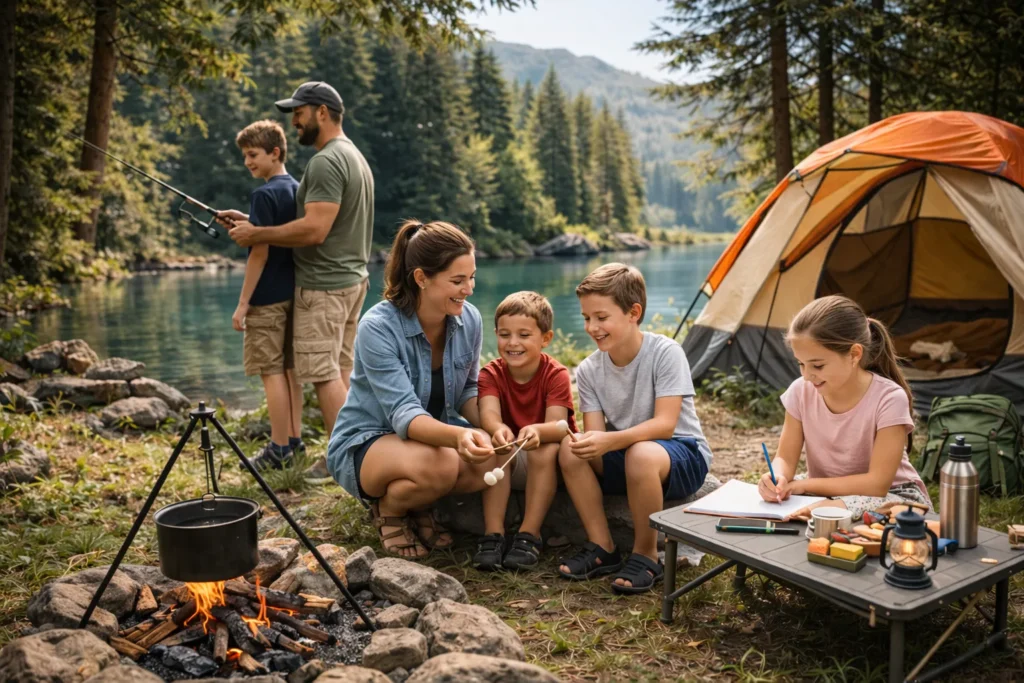
Plan a few reliable, kid-friendly recipes you can scale to group size. Classic choices: foil packet dinners (veggies + sliced sausage), skewered marshmallows and fruit, and pre-mixed pancake batter reheated on a griddle.
Assign tasks by age: older kids handle chopping with supervision, younger kids assemble skewers or stir batter. Pack a small cutting board, a serrated knife, heavy-duty foil, and a compact griddle or long-handled skillet.
Follow basic fire safety: keep a water bucket nearby, use long-handled tools, and let coals settle before cooking directly on embers. Test food temperatures and teach kids to use a fork or stick safely rather than bare hands.
Camping Games for All Ages
Choose games that require little gear and scale to different ages. Bring a frisbee, a deck of cards, glow-in-the-dark bracelets, and a simple ball. Games to try: capture-the-flag on an open meadow, flashlight tag after dusk, and a campsite scavenger relay.
Adapt rules so everyone contributes. For capture-the-flag, let younger players have two lives or smaller territory. For card games, teach one quick trick or play cooperative rounds where teams work together.
Keep a short schedule so games don’t overrun meal or quiet time. Rotate between high-energy and calm activities—one round of Spikeball or frisbee, then a storytelling or drawing challenge to wind down.
Wildlife Watching Experiences
Research the local wildlife before arrival and print approachable ID cards—common birds, mammals, and insect species. Pick early morning or dusk for the best sightings and teach quiet observation techniques: slow movements, soft voices, and binocular etiquette.
Set up a short stakeout: pick a sheltered spot near a water source or berry patch, sit quietly for 10–20 minutes, and record sightings on a simple log sheet. Use a phone camera with zoom instead of approaching animals. Emphasize respect: no feeding, no chasing, and keeping distance for safety.
Turn observations into learning moments: compare tracks, sketch a bird’s beak shape, or note behavior differences between species. These small exercises build awareness and leave kids with concrete skills for future trips.
Making Memories While Camping
You’ll create lasting moments by picking activities that invite curiosity, teamwork, and simple hands-on fun. Focus on clear roles, easy-to-follow steps, and a relaxed pace so everyone from toddlers to grandparents can join.
Stargazing Nights
Lay out a dark blanket away from campsite lights and point a red flashlight at your star map to preserve night vision. Use a smartphone app to identify constellations, planets, and bright stars; show a child how to find Orion or the Big Dipper as an easy starting point.
Bring a small telescope or binoculars for sharper views, and assign short “spotter shifts” so each family member takes turns scanning the sky. Turn it into a game: give each person a list of three things to find (a planet, a named star, a meteor) and reward completed lists with hot cocoa or a badge.
Talk about how stars change position through the night and why you see more as the sky darkens. Keep sessions to 20–40 minutes for younger kids, and end with a quiet moment to name a family constellation or star for memory keeping.
Creative Outdoor Crafts
Pick crafts that use found natural materials—pinecones, leaves, smooth stones—and bring a small kit with glue, twine, and washable paint. Show kids how to press leaves between wax paper for instant keepsakes or paint stones with family initials to mark tent spots.
Set up stations: one for natural collages, one for camp jewelry (twine and beads), and one for nature journals where everyone sketches or writes a single favorite moment. Limit each project to 15–30 minutes so attention stays fresh and cleanup stays simple.
Use craft time to teach observation: ask each person to collect three different textures or colors and explain why they chose them. Photograph finished projects for a digital album you can print later.
Team-Building Activities
Choose short, achievable challenges like a three-legged race, tent-pitch relay, or an obstacle course using logs and ropes. Assign roles—navigator, builder, timer—so every family member contributes according to age and ability.
Design a simple scavenger hunt with a clear checklist and safety boundaries. Include tasks that require cooperation (carry a stick together, form a human bridge) to encourage communication and problem-solving under light pressure.
Debrief for 5 minutes after each activity: ask what worked, what was funny, and one thing to try differently next time. Keep rules simple, praise effort, and rotate leadership so everyone feels ownership of the memory.